A Space for curious minds who believe life keeps expanding.
A Space for curious minds who believe life keeps expanding.
The Colosseum, Rome — Stepping Into History
15 June 2022
Visiting the Colosseum in Rome marked an important moment in my journey through the New Seven Wonders of the World.
By this point, I had already explored Machu Picchu, the Great Wall of China and Chichén Itzá — and standing here in Rome felt like stepping into another chapter of history.
As a solo traveller, I often explore independently and then join a local guide once I arrive. For the Colosseum, that proved to be the right choice — there is so much to take in, and the stories behind it bring the place to life.
First Impressions
Nothing quite prepares you for the scale.
Built in AD 80, the Colosseum is the largest ancient amphitheatre ever constructed, once holding up to 50,000 spectators. Today, it remains one of Rome’s most visited landmarks — and understandably so.
Even with visitor numbers carefully managed, it still felt busy. There’s a steady flow of people, all moving in the same direction (you’re guided to turn right on entry — rather like boarding a plane, though without the luxury of a first-class cabin!).
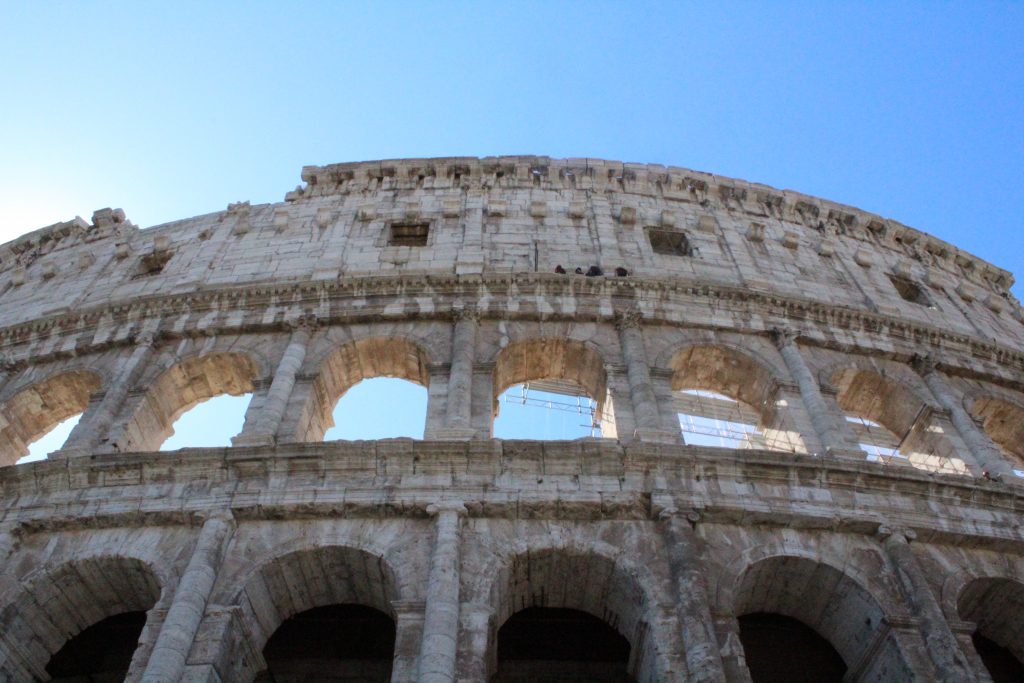
My favourite photo with the curved structure against the clear blue sky!
Inside the Arena
Standing inside the Colosseum is an experience in itself.
At the centre lies the arena — once a stage for gladiatorial contests and spectacles. The original wooden floor, covered with sand, absorbed the brutality of what took place here.
Today, part of the arena has been reconstructed so visitors can walk across it, while the other half reveals what lies beneath.
And that’s where it becomes truly fascinating.
Beneath the Surface
Below the arena floor is a complex network of tunnels and chambers — an extraordinary feat of Roman engineering.
From above, you begin to understand the scale and organisation required to stage these events. But it also brings a deeper awareness of what happened here — animals, fighters, and people forced into combat.
I found it quite eerie.
There’s a weight to the place… a sense of history that’s impossible to ignore.
A Monument Shaped by Time
Over the centuries, the Colosseum has endured neglect, damage, and restoration.
Much of its original marble and stone was stripped away and reused elsewhere, leaving behind visible scars — including the small holes in the walls where iron clamps were once removed.
Even today, restoration work continues.
And yet, despite everything, it still stands — powerful, imposing, and deeply symbolic.
One of the ceilings of the hallway in the Colosseum.
An ancient Roman Sculpture - it was said to be a man on a horse! I couldn't visual it, I just had to use my imagination!
The Experience
Climbing to the upper levels (which require a guided tour) gave a different perspective. The stairs were uneven in places — a reminder that this is still an ancient structure — but the views were worth it.
From above, you really appreciate the scale of the amphitheatre and its place within the wider landscape of ancient Rome.
Of course, like many popular landmarks, it’s difficult to avoid the crowds — but a little creative cropping works wonders for photos!
Mollywozhere photo, naturally.
Was It Worth It?
Absolutely.
The Colosseum is not just a historical site — it’s an experience. One that connects you to the past in a very real and sometimes uncomfortable way.
It’s easy to admire the architecture and engineering, but it also prompts reflection on the lives and events that shaped its history.
For me, it was both fascinating and humbling.
And without question, it deserves its place among the Wonders of the World.
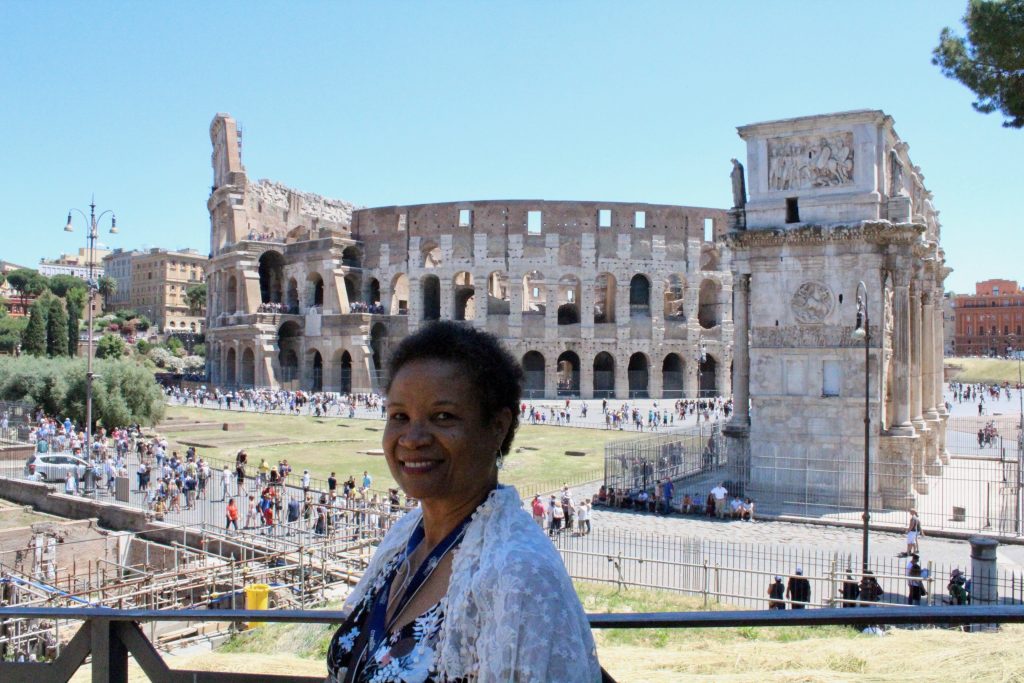
The Colosseum is very close to other archeological and ancient ruins in Rome where this photo was taken.
This was another step in my journey through the Wonders of the World. You can also read about Petra, Machu Picchu, the Great Wall of China, and Christ the Redeemer as I continue exploring these remarkable places.
Cruising through the limestone karsts of Ha Long Bay was one of the highlights of my Vietnam trip — breathtaking scenery, peaceful waters and unforgettable…